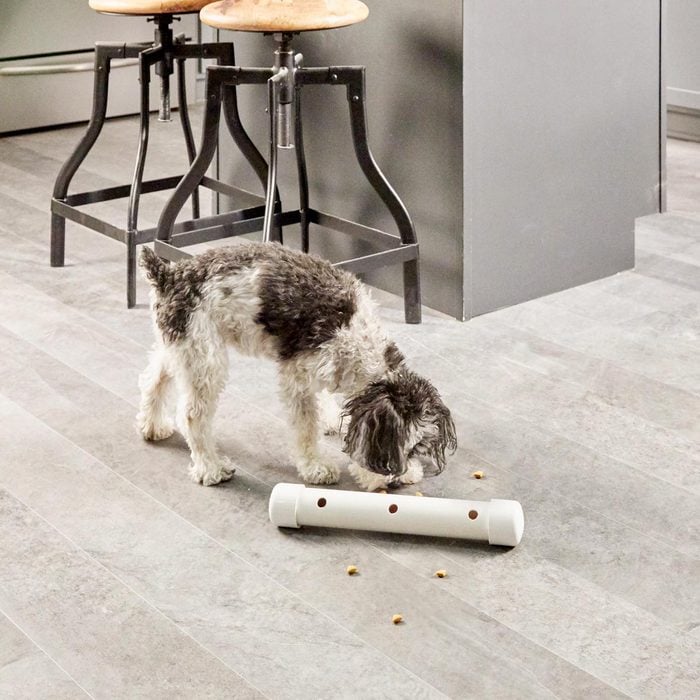
My puppy was eating his food too fast and vomiting it right back up. Instead of buying a slow-feed bowl, I drilled holes in a 12-inch length of 2-in. PVC pipe and capped the ends. Then I filled the tube with puppy food.
My puppy has to roll it around to get the food to fall out of the holes. That slows him down and avoids the mess. Be sure the holes are large enough for the food to come out! – Charlie May.
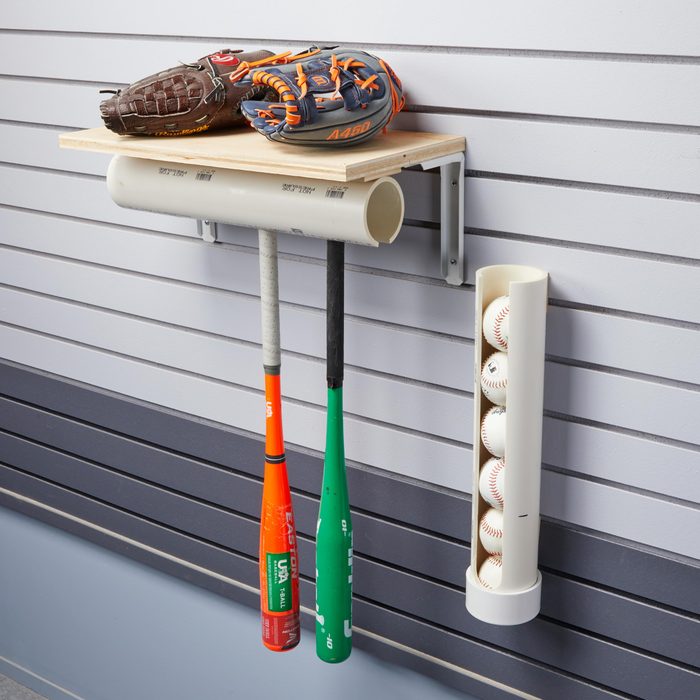
If you have baseball and/or softball enthusiasts in your family, build this bat and ball holder with four-inch PVC pipe and caps to keep their equipment organized. — Randy A. Michel.
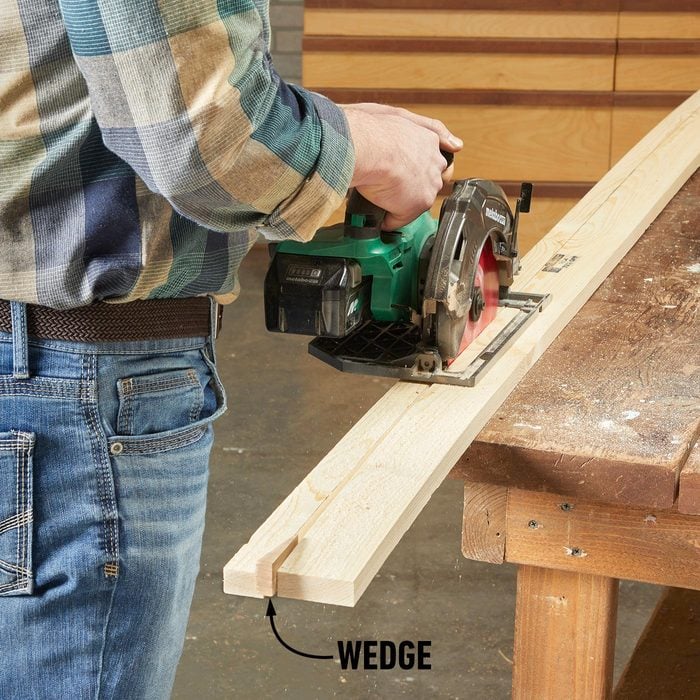
When ripping a bowed piece of lumber with a circular saw, here’s how to keep the strip you’re cutting off a consistent width for the full length of the board:
Line up the saw blade with the cut mark at the desired width. Make a pencil mark on the shoe of the saw directly above the board edge. Now when you push the saw the length of the board, just keep the pencil mark on the shoe lined up with the edge of the board.
Important: Before cutting one-third of the way, tap a wedge into the cut to keep it from closing up and causing the saw to kick back. — Thomas Roberts.
Potted bulbs are always a cheerful sight at grocery stores, florists and nurseries around Easter and Mother’s Day. It’s fun to bring colorful blooms inside to enjoy on the kitchen table for a few weeks. But what happens when the flowers are all spent?
Some people simply toss them in the compost pile. For bulbs that aren’t perennial, that’s probably the best option. But there are a few types of potted bulbs worth saving to plant in your garden.
Which Kinds of Spring Potted Bulbs are Worth Replanting?
Just as many garden flowers are annuals or perennials, spring bulbs fall into similar categories. Some are prolific the first year but may return weak or not at all the second year. Other types of bulbs can live for a few years or even decades if you transplant them out into the landscape.
Reliably hardy spring bulbs
Miniature and full-size daffodils;
Crocuses;
Snowdrops;
Squills;
Grape hyacinths;
Windflowers;
Summer snowflake;
Species tulips such as Tulipa clusiana ‘Lady Jane;’
Easter lilies (Lilium longiflorum).
Shorter-lived perennial spring bulbs
Allium;
Hyacinths;
Dutch iris;
Fritillaria.
Spring bulbs best grown as annuals
Most types of tulips;
Ranunculus;
Freesia;
Paperwhites;
Any bulbs grown in water rather than in soil.
If your spring potted bulbs fall into the reliably hardy or short-lived perennial categories, it’s worth the effort to try and save them. Generally, smaller bulbs that tend to naturalize in the landscape have a better chance of surviving another year.
Unfortunately, these minor bulbs aren’t typically sold as potted gift plants for spring. That’s because people are far more likely to purchase a big pot of fragrant hyacinths or bright pink tulips on impulse. If your potted bulbs fall into the annual category, it’s better just to compost them.
Of the plants listed above, most people are surprised by tulips. The process of artificially chilling tulip bulbs and forcing them to bloom out of season for spring holidays saps so much energy out of them they often don’t recover enough to bloom another year. It’s best to enjoy their beauty in the pot, then toss them.
How Do I Make My Potted Bulbs Last?
Think about the weather outside when spring bulbs bloom in your garden. The days are cool and nights are even cooler. Spring rain showers are common, which means skies are often cloudy.
To mimic that environment as much as you can indoors, set your potted bulbs in a cool, bright location but not in direct sunlight. If you can, move them someplace a little cooler at night. Avoid warm temperatures; they make the flowers mature quickly so they won’t last as long.
As you do with your other houseplants, water your potted bulbs when the top inch of soil is dry. Never let the pot sit in standing water. These tricks will help the flowers last longer, but even so, they shouldn’t be expected to bloom more than a couple of weeks. Spring bulbs are delightful, but brief.
What Should I Do with My Potted Flowers Once They Are Spent?
If your potted bulbs are reliably hardy or short-lived perennials, you could save and plant them out into your garden. Follow these five easy steps:
When the flowers fade, trim them off but leave the leaves. The plant needs the energy they contain to drain back into the bulb. Continue to water the plant as long as its leaves are green.
Once the plant starts to turn brown and go dormant, stop watering it. You want the whole plant to turn brown. Then gently tug on the foliage to remove it. If it doesn’t break away easily, it’s not ready yet.
You have two choices for handling your potted bulbs at this stage: plant them out into the garden or store them for planting in the fall. Bulbs do best in drier soil when they are dormant, so if your garden is heavily irrigated or your soil tends to stay moist, store the bulbs and plant them in the fall. If you have a dry, sunny spot in the landscape, plant the bulbs right away.
To store, simply set the pot of bulbs in a cool, dry, well-ventilated place. Or take them out of the pot, shake the soil off and set them in a crate or cardboard box to dry.
Plant the stored bulbs in the fall along with any new bulbs you’ve purchased.
No backyard? No problem. At last count, plant expert Summer Rayne Oakes had more than 1,000 plants inside her Brooklyn apartment. She gets so many questions on plant care that she started a YouTube channel to help people with everything from watering schedules to propagating to upcyling tea tins into plant containers.
Hearing her story of bringing the outdoors inside inspired us to learn more about how to buy indoor plants online, then make sure they’re happy and thriving. Oakes gave us her expert tips on purchasing and caring for indoor plants. Green thumb, here we come!
Do Research Before You Buy Indoor Plants Online
We’ve all been browsing online or at the garden center and seen a plant or succulent too pretty to pass up. Two months later, you’re tossing the dead brown or yellow leaves in the trash.
Before you add anything to your cart, Oakes recommends doing some due diligence. Start with the basics. “It’s good to understand the quantity, quality and intensity of light in your home,” she says. If you have dim early morning sun and buy tropical plants that require intense sunlight, you’re setting yourself and the plant up for failure.
Also consider your tendencies as a plant owner. “Are you someone who wants to follow a strict routine with indoor plants?” Oakes says. “Or do you travel a lot and have a tendency to neglect plants?” Then shop for low or high maintenance plants accordingly. You can also look for grow lights or heat pads if your heart is set on a plant that won’t thrive under the natural conditions of your home.
Finally, its fine to shop for plants online! Oakes uses sites like Etsy, Terrain and Steve’s Leaves to find plants, seeds and propagations. She also suggests checking local plant stores to see if they offer delivery or curbside pickup.
Indoor Plants You Can Buy Online
While it’s possible to grow most plants indoors with the right natural or artificial light, we asked Oakes for her recommendations. “Some plants and trees have a resiliency to withstand a variety of water and light regimens,” she says. Here are a few of her top picks.
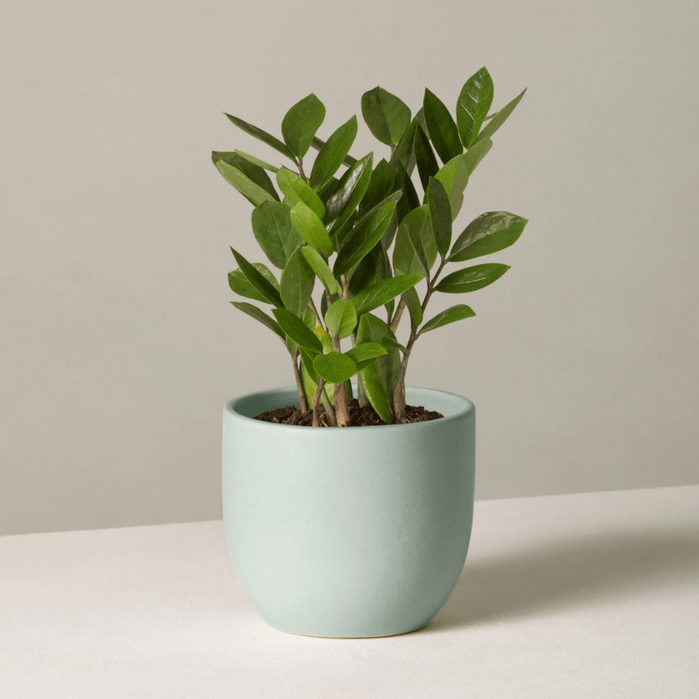
ZZ Plant
First up, Oakes recommends the ZZ plant, which starts as a structural plant but fountains over as it grows larger. It’s an air purifying option that can tolerate low light, making it the perfect indoor plant for beginners.
Oakes suggests watering all the way around the plant. “If you water in just one area that can push away soil, expose roots and encourage roots to grow one way,” she says.
Want to hang an indoor plant? Oakes likes silver pothos plants for hanging baskets. “I’ve been growing these in a range of conditions in my house and they do well even in dryer conditions,” she says.
Choose a pot or container with a drainage hole in the bottom. “Decorative containers without any drainage will easily kill a plant,” she says. Consider drilling a hole in the bottom or a pot you love. Don’t forget to add a basin underneath to catch water and protect your furniture or windowsill.
Succulents seem like a no-brainer indoor plant to buy online, but looks can be deceiving. “Some of us don’t have proper light to grow succulents indoors,” Oakes says. “It’s also easy to water them wrong.”
She suggests an ox tongue succulent, which is more tolerant to moderate light conditions. For soil, Oakes recommends adding a grittier or bonsai mix to standard soil. Traditional potting soil is hard to rewet when it completely dries between waterings.
Fairy washboard or Haworthia succulents are another Oakes-approved suggestion. “These are a hardy plant, and they don’t grow very big which means they’re easily contained,” she says. “These are the succulents that can live on your table or desk.” Just be sure they’re in a container with drainage at the bottom or the roots will rot.
Looking for a tree to grow indoors? Oakes recommends umbrella trees for their leafy structure. With bright indirect light it can grow up to five feet tall. Oakes suggests keeping them in their nursery pot. If you want something prettier, camouflage it with a basket Just be sure to add a basin to collect water.
A bird of paradise sort of resembles a tree, with banana leaf-looking leaves. It’s a tropical plant so it needs a sunny spot to thrive. If you have an outdoor area like a fire escape or balcony, Oakes suggests moving the plant there in the warmer months.
Mold and mildew are common issues that plague many households. Experts believe up to 70 percent of U.S. households have some kind of mold.
While mold is an unwanted and often unpleasant household guest, its effects go beyond the surface. Mold can cause asthma, allergies and upper respiratory infections. That’s why killing mold is more important for your health than you may think.
Mold and mildew, though similar, present different challenges to remove. Here’s how to tell them apart, and how to effectively get rid of mold and mildew for good.
What Is Mold?
Mold is a fungi that grows and thrives where moisture and oxygen are present. Outdoors, mold can be found in places like soil, plants and dead or decaying matter. Indoors, mold growth can occur on wood, carpet, paper, foods and insulation.
What Is Mildew?
Mildew is a type of early-stage mold that generally grows on flat, moist surfaces. It tends to live on shower walls, windowsills and other places with high levels of moisture. Both mold and mildew are sometimes referred to as blight, fungus, must or decay.
Mold and Mildew, Compared
Although mildew is a type of mold, several key characteristics differentiate mold and mildew. Here’s how mold and mildew are different and alike.
Colors
Color is the biggest difference and the easiest way to tell the two apart. Mold is generally green, red, blue or black, while mildew is white or gray.
Texture
Texture is another key indicator. Mold takes on a slimy or fuzzy look. Mildew, on the other hand, tends to be dry or even powdery.
Height
One way to tell mold and mildew apart is their height. Mold is often raised, while mildew appears flat.
Causes
The same culprit causes both: moisture. Mold and mildew can grow in any damp environment inside or outside your home. Moisture sources like roof and foundation leaks, excessive interior humidity, overflowing washing machines and flooding create a potential breeding ground for mold.
Smell
Surprisingly, you can sometimes tell mold and mildew apart by smell. Mold tends to be more pungent, especially as it grows. Mildew has a milder, musty smell that some people compare to damp socks.
Temperature tolerated
Mold and mildew thrive in temperatures above 70 F. Because appliances generate a lot of heat, they’re optimal areas for growth. Mold and mildew typically stop growing when temperatures reach 140 F or higher, or when temps dip below 40 F.
Where they grow
Mold can grow on paper products, cardboard, ceiling tiles and wood products. It can also grow in leaky areas like roofs, windows or pipes. Paint, wallpaper, drywall. upholstery and dusty spots are susceptible as well. Mildew can grow in the same places, but prefers flat surfaces like untextured ceilings and shower walls.
How they spread
Mold and mildew are prolific reproducers. They spread by releasing millions of tiny spores invisible to the naked eye through air or water. Once these spores attach, growth can be extremely fast.
How To Clean Mold and Mildew
Mold and mildew require different cleaning methods. If you’re only dealing with mildew, remove it with a store-bought mildew cleaner and a good scrubbing brush. Simply spray, let sit for five to 10 minutes, then scrub away. Wipe off any remaining mildew with a clean paper towel or cloth.
Mold requires a more rigorous cleaning process, according to Zach Houghton, CEO of Loftera, a U.K.-based company providing construction and renovation services. You can try the method above for mildew removal or mix a homemade solution.
“A spray bottle containing two teaspoons of borax and 1/2 cup white vinegar can be used,” Houghton says. “Spread the mixture over the mold and leave it for 30 minutes to dry. In conjunction with the borax, the white vinegar will eliminate mildew and mold from the surface.” Then rinse the area with clean water and let dry thoroughly.
Houghton says you may need professional help to completely get rid of mold. “It is advisable to call an expert to inspect any mold problem you have in the long run,” he says. “Molds are still capable of producing toxic spores when dead, so even cleaning them doesn’t eliminate their harmful effects.”
How To Prevent Mold and Mildew
Luckily, there are several ways to prevent mold and mildew. Houghton suggests immediately removing if possible any household items or surfaces with mold or mildew growth, like ceiling tiles. Try to keep humidity in your home below 60 percent. You can manage humidity with a dehumidifier.
Cleaning your home at least twice a month can also prevent mold growth. Lastly, when cooking, washing dishes or cleaning, run exhaust fans to move moisture outside. If you notice leaks, immediately clean them up and make required repairs.
Earlier in March, the Federal Trade Commission (FTC) issued an administrative complaint against HomeAdvisor, Inc. claiming the company used “deceptive and misleading tactics” when selling leads on home improvement projects to service providers and small businesses.
The complaint alleges that HomeAdvisor, a company affiliated with Angi (formerly Angie’s List), knowingly misrepresented the quality of the leads it provided to its members.
“Since at least July 2014, HomeAdvisor, through its sales agents and marketing materials, has made representations to service providers about the quality, characteristics, and source of HomeAdvisor’s leads that are false, misleading, or unsubstantiated,” the complaint says.
“HomeAdvisor represents that its leads concern people who intend to hire a service provider soon, even though many of them do not.”
According to the FTC, HomeAdvisor deceived service providers by claiming its leads would land them home improvement jobs at higher rates than HomeAdvisor’s in-house data suggested. The FTC also claims that HomeAdvisor misled members regarding the cost of a subscription to an optional software platform.
“Gig economy platforms should not use false claims and phony opportunities to prey on workers and small businesses,” said Samuel Levine, director of the FTC’s Bureau of Consumer Protection, in a press release. “Today’s administrative complaint against HomeAdvisor shows that the FTC will use every tool in its toolbox to combat dishonest commercial practices.”
An Angi spokesperson refuted the claims in the complaint, calling them “outrageous,” “meritless” and “out of touch.”
“The FTC allegations against HomeAdvisor are based on a false narrative using a small handful of cherry-picked, incomplete, and out-of-context recorded sales calls — to serve their agenda,” the spokesperson told FH in an email. “The reality is much different.”
According to Angi, HomeAdvisor has generated “tens of millions” of leads since 2014, with less than four percent resulting in a service provider requesting credit due to a task or location mismatch.
“Fraud and deception don’t work as business models,” the Angi spokesperson said. “If our pros don’t win, we don’t win.”