Standard track lighting features a rigid track mounted to the ceiling, with heads or pendants attached. Johnson says this type is ideal for “kitchens without recessed lighting, living rooms with limited power sources, and is an especially great option for wood ceilings where you cannot install recessed cans.”
Line-voltage, a direct extension of your home’s existing electrical circuit, powers standard track lighting. According to Nick Yahoodain, CEO of Advanced Builders and Contractors, line-voltage lighting is much more DIY-friendly because it doesn’t require installing a separate transformer, as low-voltage systems do.
According to Johnson, depending on the number and type of heads, cost can range from a few hundred dollars up to $1,800 for a 175-sq.-ft. kitchen. This Nuvo Lighting Track Kit ($214) includes a four-foot track and three LED bulbs.
Most homeowners close the overhead garage door and assume they’ve locked out any unwanted visitors. And they’re mostly correct; a garage door connected to an opener is pretty secure. But there are a few ways that crooks might still be able to get through your door. Here, we will show you how they do it—and how to stop them.
Prevent Fishing
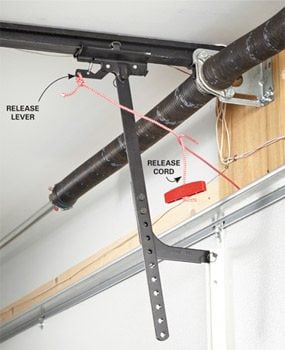
By pushing the door inward to create a gap at the top, a crook can insert a wire hook and fish for the release cord. Some use a wedge to hold the gap open. Once the cord is hooked, all it takes is a good yank to disconnect the door from the opener. On some garage door models, hooking the release lever works too.
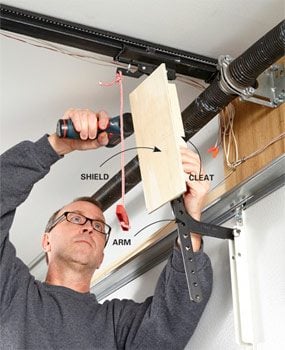
Make a Garage Door Lock Shield
A garage door lock shield makes grabbing the release cord almost impossible. This shield is simply a wood cleat and a scrap of plywood screwed to the opener’s arm. The plywood is fastened to the cleat with just two brad nails, so it can break away— rather than do damage—if it runs into something while the door is traveling.
Add a Tie
If your trolley has a pair of holes, you can make a garage door lock with the release and a small plastic zip tie. Use the smallest tie you can find. It will be strong enough to resist the tug of a fishing wire but will break away with a hard pull on the release cord.
Every garage door opener has an emergency release that disconnects the door from the opener. Without it, you wouldn’t be able to open the door when the opener is on the fritz. But some clever crooks have turned this essential feature into a security risk.
Keep in mind that “fishing” a garage door isn’t exactly easy. In some situations, it’s almost impossible. Some garage door openers have a release mechanism that must be pulled straight down and won’t release if the cord is tugged at an angle toward the door. Others are a bit easier to fish, especially if your garage door has a window that allows the crook to see what they’re doing.
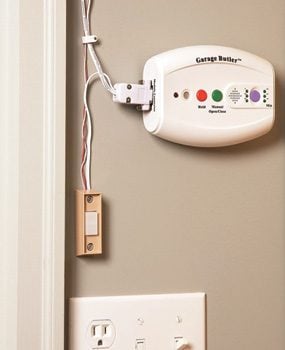
Add a Garage Door Monitor
The monitor receives the signal from the sensor and displays whether the garage door is open or closed. Sensors and monitors are battery-operated—no wiring is required.
Automatic Door Closer
Garage security is often undermined simply because someone forgot to close the door. An automatic door closer gives you more security by closing the door whether you’re home or not. Installation requires some simple low-voltage wiring and takes less than an hour.
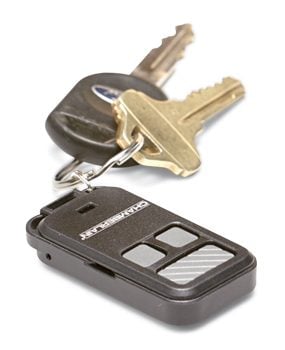
Keep Your Opener With Your Keys
It’s simple: If you take your garage door opener with you, thieves can’t steal it from your car. A keychain remote just makes sense.
A thief who breaks into your car can grab the remote for easy access to your garage. This isn’t just a problem when your car is parked in the driveway; the registration card in your glove box gives a crook your address.
So get rid of the remote on your visor and buy a keychain remote. You can easily take it with you every time you leave the car.
Lock the Track
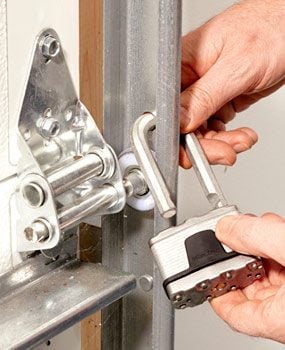
If your door doesn’t have a lockable latch, drill a hole in the track just above one of the rollers and slip in a padlock. This is a good idea if you’re going on an extended trip and won’t need to get in and out of your garage for a while.
5 More Ways To Lock Down Your Garage
Beef up the service door. The walk-through entry door (called the “service door”) is the number one security weak spot in most garages. It should be equipped with a deadbolt and a heavy-duty strike plate, just like any other exterior door in your house.
Lock the entry door. If you have an attached garage, lock the entry door that leads into the house. Too many homeowners rely on the service door and leave the entry door unlocked.
Cover windows. If crooks can’t see the tools and toys in your garage, they won’t be motivated to get in. Sheer curtains or translucent window film lets in light but keeps valuables out of sight.
Add lighting. Bright lighting makes burglars nervous and just might make them go elsewhere. Motion detector lighting is better than on-all-night lighting because it saves energy when it’s off and attracts attention when it’s on.
With recent reports that rat sightings are up 71% in New York City since 2020, and infamous videos like the subway pizza rat still circulating, you’d think the Big Apple would easily take the prize as America’s most rat-infested city. But in Orkin’s annual survey of rattiest cities, New York only checks in at number two. Chicago took the top (or bottom) prize for the eighth consecutive year.
Los Angeles came in third, followed by Washington, D.C., San Francisco, Philadelphia, Baltimore, Cleveland, Detroit and Denver among the top 10. Hartford, Connecticut, and Miami entered the top 20 this year. Orkin ranked metro regions by the number of new residential and commercial rodent treatments performed from Sept. 1, 2021, to Aug. 31, 2022.
Orkin’s list suggests there’s no corner of the U.S. free from rodent problems. Each fall, as the weather turns cold, mice and rats invade an estimated 21 million homes.
Still, it’s important to keep the rat problem in perspective. There’s a century-old myth that as many rats as people live in major cities. That’s not accurate; more recent studies have shown New York City has about two million rats in a city of eight million people. But even one rat or a handful of mice can be a major problem for homeowners.
“Rodent infestations are among the top pest issues of the fall and winter seasons,” said Ben Hottel, an Orkin entomologist. “Not only are mice and rats a nuisance, but they are known to spread a variety of dangerous diseases, including salmonella and hantavirus.”
Orkin says the most important thing is to be proactive. Try to spot an infestation early. Look for droppings in cabinets and pantries, under sinks, inside cardboard boxes, along baseboards and in your yard. Keep an eye out for gnaw marks on walls and wires, nests in dark corners of the basement or attic, and strange scurrying noises inside the walls.
By being proactive, you can hopefully avoid buying rat traps. If you do see signs of a major infestation, call a professional exterminator.
How Can I Keep Rats and Mice Out of My Home?
Rodents love small crumbs and garbage, so be sure to keep surfaces clean and store all food in sealed metal, glass or plastic containers. Declutter cardboard and paper products rats and mice could chew on and nest in.
Maintain your landscaping by cutting the grass and trimming tree branches away from the home. Seal any holes and cracks in your exterior walls and foundation that could be an entry point for critters.
It’s easy to buy just about anything online, from the cars we drive to the clothes we wear. Live plants are no exception.
Some people live where there isn’t a garden center within 100 miles. Others can only find time to shop for plants late at night after everyone else has gone to sleep.
Buying plants online is a major convenience, plus you can find some one-of-a-kind varieties you won’t see in most stores.
However, before you begin, there are some things you should be aware of. Here are 10 tips to ensure your online plant-buying experience is a success:
Order at the Right Time
Garden plants are seasonal. Not all are available at the same time of year, so you’ll need to learn which types to look for in the appropriate seasons.
Generally, the sooner you place your order, the more likely you are to find what you need in stock. Once an item is sold out, you will usually have to wait until the following year to try and purchase it again.
Order summer blooming bulbs from early fall through winter, for fall and spring planting.
Order seeds from January through early spring, for late winter and spring sowing.
Order annuals, perennials, trees and shrubs in winter, for spring shipping or in summer for fall shipping.
Check the ship date of your order to make sure your plants will arrive in the appropriate planting season. Most online plant companies will send them at the proper time. But some will ship anything you order immediately, which may leave you stuck with plants you can’t use.
Shop for Unique Plants From Specialty Growers
Standard flats of flowering annuals can be purchased at any garden center in the spring, so don’t bother ordering those online. Instead, look to specialty growers who focus on specific species you aren’t likely to find locally.
MrMaple.com sells hundreds of varieties of Japanese maple trees exclusively by mail order. B&D Lilies offers bulbs from award-winning breeders. Daffodil varieties that date to the 1800s are sold online by Old House Gardens Heirloom Bulbs. Unique varieties of organic vegetable, herb and flower seeds can be delivered to your door by Select Seeds.
Know Your Zone
Unlike your local garden centers, which only stock plants appropriate for your climate, online sellers service the whole country. Not everything on their website will grow where you live. That’s why it’s important to know which U.S. Department of Agriculture Plant Hardiness Zone you live in, so you can look specifically for items that will grow in your climate.
Experienced gardeners sometimes intentionally purchase plants from online sellers knowing they’re not rated for their hardiness zone. They may have a special place to overwinter them or might be willing to take the risk that the plant may not survive. We call this “cheating your zone,” which is essentially trying to beat Mother Nature at her game. Not surprisingly, she usually wins.
Read the Reviews
Most online sellers post customer reviews, so be sure to read them if you’re ordering for the first time. Also, seek out reviews on independent sites like Google and Yelp. Your fellow plant collectors may be willing to share their experiences of buying plants online, too.
Keep in mind they’re reviewing live plants, so user error may account for some of the poor experiences.
Ask yourself if, after reading the reviews and guarantees, the seller appears to be reputable. Is this someone selling plants they’ve dug out of their backyard, or is this an established greenhouse required to adhere to USDA regulations?
Check the Location of the Seller
When you search for plants online, sellers from all over the world will come up in the results. If you live in the U.S., always buy from an American company because USDA regulations prohibit individuals from shipping live plants across the U.S. border.
Growers are required to complete extensive inspections and mountains of paperwork to be allowed to ship from outside the U.S. These government regulations protect our country against the importation of foreign pests and diseases.
The “About” page on a seller’s site should clearly state where they’re located. Another way to verify they’re U.S.-based is to check if their prices are in U.S. dollars and if they accept payment that way.
Verify the Accuracy of the Plant Variety
If you come across a plant you’d like to buy but have never seen before, do a quick search on Google Images. If all the photos there look similar to the seller’s, you’ll know it’s accurate.
This is an easy way to spot photos embellished to the point of inaccuracy. It prevents the disappointment of ordering what you thought was a hot pink lily that actually blooms a washed-out pink.
Determine the Plant Size You Will Receive
Generally, when you buy plants online, you should expect to receive a smaller plant than your local garden center offers. People who aren’t accustomed to buying plants online are commonly disappointed when they open the box after waiting months for their plants to arrive, only to find their new tree is a one-foot-tall whip instead of a six-foot-tall mature specimen.
Before you place the first item into your online shopping cart, scour the website to find out the sizes of the plants they’re selling. If the cost is high for a small plant, it might not be worth your time.
Check the Seller’s Guarantee
The guarantee for live plants varies tremendously by vendor. Large greenhouses can accommodate greater numbers of losses from claimed plants and may have a more generous guarantee than smaller sellers offer.
Oftentimes, when the seller knows they don’t have enough stock to replace plants, they’ll ask you to plant what you receive and monitor its growth. Usually, when a plant is damaged in shipment, it will recover over time. You might be happier with this outcome rather than a credit, which leaves you with cash but no plants.
Plant sellers will not ask you to return any plants. Once the plant leaves the seller’s greenhouse, it can’t be brought back because of pest and disease control protocols. Instead, they’ll ask you to send a few photographs to verify the damage, so be sure to snap a few before tossing out the plant.
Expect High Shipping Costs
Amazon and other giant retailers trained many of us to expect free shipping for just about everything, whether it’s a new couch or a pack of paper towels. Don’t expect free shipping on live plants. Be prepared to pay up to 50 percent of the total order for shipping.
High shipping costs drive many plant buyers to shop at their local garden centers rather than online. If you can buy a plant locally, do it. But if there’s something you can’t live without and you’ll only find it online, be prepared to pay a premium.
Why the high cost? Live plants are often transported on more expensive temperature-controlled trucks and expedited schedules. They require special packaging to mitigate damage, and they’re heavy. All these factors add to the cost but are necessary to ensure your plant arrives in good shape.
Do a Test Run
Before placing a large plant order with a company you’ve never done business with, do a test run. Purchase one or two items to check their condition and quality upon arrival.
If there was a problem with your order, was the seller responsive when you contacted them? Was the issue avoidable? If you feel the value isn’t there, move on to a different online seller.
A couple renovating a kitchen in England was shocked to discover more than 260 gold coins dating back more than 600 years, according to the BBC. The report said the coins were sold by Spink & Son auctioneers in Bloomsbury, London, for £754,000, including the final purchase and fees — roughly $742,000 by current exchange rates.
The coins, believed to be from 1610-1727, belonged to the Fernley-Maisters, a “Hull family involved in Baltic trading,” according to the BBC. Dozens of investors purchased portions of the stash. The most valuable, an “imperfectly minted coin from 1720,” sold for £62,400, or roughly $61,455.
BBC reported the coins were discovered in the Ellerby, East Yorkshire, home in 2019 but sold only recently. They were found inside a pot about the size of a soda can underneath concrete and 18th Century floorboards. The report did not identify the couple who made the discovery, and it’s not clear when the coins were hidden in the home.
“Picture the scene: you’re choosing to re-lay your uneven kitchen floor, you put a pick axe through the concrete and just beneath you see a tiny sliver of gold,” auctioneer Gregory Edmund said, according to the BBC. “At the time, you think it must just be a bit of electrical cable, but you find it’s a gold round disc and beneath it there are hundreds more.”
The auction house called the finding one of the largest hoards of 18th Century English gold coins found in Great Britain.
“I have never seen a response to an auction like that before, and the results testify it, my provisional estimate was demolished three times over,” Edmund told Business Insider. “It dwarfed any pre-conceived expectations and set dozens of world records along the way.
“The story was extraordinary, and that is what achieved the mind-blowing result. I do hope people think before ripping up their floors, though.”
For something that just gets flushed down the sewer, toilet paper sure has a refined background. Most popular toilet paper brands use 100 percent virgin wood fiber, which comes from vast stretches of pristine boreal forests. Cutting down these forests releases huge stores of carbon, contributing to climate change.
If making toilet paper this way seems wasteful to you, you’re not alone. Some companies are taking notice of consumer demand for sustainable and renewable products and offering recycled and alternative-fiber tissue. Pressure from advocacy groups, the public and investors seems to be working.
Recycled paper gives the best climate return, but alternative fibers like bamboo have a part to play. “Bamboo fiber has a much smaller climate impact than fiber from primary forests, but a larger impact than fiber from recycled content,” says Ashley Jordan of the Natural Resources Defense Council (NRDC) and author of The Issue with Tissue 2.0.
What Is Bamboo Toilet Paper?
As the name suggests, bamboo toilet paper is made from bamboo, a fast-growing grass, instead of wood pulp. Bamboo is more efficient to plant and harvest than traditional crops. Depending on who you talk to, bamboo toilet paper looks and feels like regular toilet paper.
Pros and Cons of Bamboo Toilet Paper
Bamboo toilet paper has a lot going for it, but it’s not a cure-all. Jordan says consumers should first look for 100 percent recycled toilet paper with a high percentage of post-consumer recycled content. Bamboo’s benefits and drawbacks include:
Renewable: Bamboo regenerates quickly, and some species can grow an astonishing 36 inches per day.
Lowers emissions: Bamboo toilet paper production releases 30 percent fewer carbon emissions than virgin-pulp toilet paper.
Costs more: Even less expensive bamboo toilet paper costs more than a dollar per roll. Some brands are higher.
Comfort: Some consumers say bamboo toilet paper is not as soft as traditional tissue.
All bamboo toilet paper isn’t created equal, either. “One of the most significant sustainability concerns is whether the bamboo was sourced from a plantation that was established through the clear-cutting and conversion of a natural forest,” says Jordan.
If you’re changing toilet paper for ethical reasons, be sure to know what you’re buying. Look for the Forest Stewardship Council (FSC) logo when buying tissue products. This mark “helps indicate to consumers that the fiber was sourced in a way that respects human rights and limits negative forest impacts,” says Jordan.
Manufacturers tout bamboo’s comfort and similarity to regular toilet paper, but what do customers say?
Amazon verified purchaser Jo recommends Caboo bamboo toilet paper because it feels like the regular kind. “I was pleasantly surprised by the softness of this tissue,” she writes.
Others aren’t quite as sold on the softness, but like doing something for the earth. Amazon verified purchaser Jackie included a video review of Reel. “It costs a little more, and it’s not as soft as other toilet paper, but it makes me feel like I’m supporting the environment with this tiny step,” she writes.
Cost is definitely a consideration, but it’s a matter of perspective. “Per roll I can’t beat the price,” M.Hance writes on Amazon about the Cheeky Panda brand bamboo toilet paper. “It’s not as soft as Charmin or quilted but it’s very nice and I love what the company stands for.”
Where To Get Bamboo Toilet Paper
Consumers can find bamboo toilet paper at Amazon and grocery stores, like Kroger and Whole Foods. Buying directly from manufacturers is an option, but you might have to pay for shipping. Check out subscription services and introductory deals to save money.
Best Bamboo Toilet Paper
So, are you ready to make the switch? Here are the best options for ease and your budget:
Best subscription bamboo toilet paper
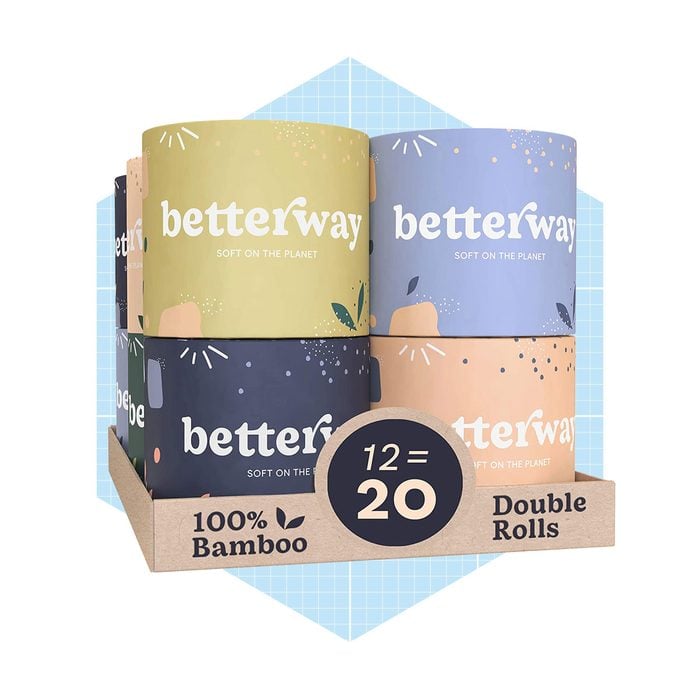
Betterway bamboo toilet paper offers a five percent discount on subscriptions through Amazon. You can get an additional five percent if you add other products to your Subscribe and Save order.
Best budget bamboo toilet paper
Bim Bam Boo’s bamboo toilet paper costs $27.99 for 24 rolls. In the world of bamboo toilet paper, that’s a steal. The company offers free shipping and $5.00 off for signing up. Bim Bam Boo makes the NDRC’s sustainable tissue scorecard with a B-plus, higher than any other bamboo toilet paper brand.
Best easy-to-find bamboo toilet paper
Reel bamboo toilet paper is available on Amazon, Walmart, Target and via the Reel website, making it one of the easier brands to find. That’s important when buying a fundamental product like toilet paper. If it’s not convenient to switch products, people won’t do it.
Over the last couple of years, I’ve used portable stoves far more than my kitchen range!
First, my husband and I renovated an abandoned house, and it took months before we had the power and propane lines hooked up. During that time we cooked on our two-burner portable propane camping stove and mini boat grill.
Now, when we’re not at home, we’re either camping in our van or staying at a studio in town that lacks a kitchen. At the latter, we cook with a portable induction burner and a toaster oven.
In truth, this isn’t the first time I’ve relied on portable stoves; it’s covered much of my life. From cooking in a hurricane recovery zone to backpacking to unconventional housing situations, I’ve come to love and depend on portable stoves of all sorts. But they’re not for everyone. Here’s how to decide if a portable stove is right for you.
What Is a Portable Stove?
A portable stove is any cooking device you can easily pack up and transport in your car. The most common ones run off propane or electricity. Depending on which you choose, they’re great for:
Disaster zones, especially for boiling water to make it potable.
Types of Portable Stoves
Whether you choose a gas-burning or electric stove depends on what you’re using it for and whether you have access to electricity and/or a ventilated space.
While some gas burners are rated for use inside, they will lower the air quality. However, if you’re in a place without power, gas is an obvious and excellent choice.
Gas portable stoves
Classic camping stoves: The most popular type, these come with two burners, usually with windscreens on the side that fold up under a lid. They run off the common green disposable propane canisters, and many can be adapted to run off a barbecue grill-size tank.
Fixed-base single-burner stoves: These have square or round bases that sit directly on a table and run off various fuels, most commonly propane or butane. They usually don’t have sides or windscreens, so they can accommodate larger pots but don’t fare as well on blustery days.
Canister-base single-burner stoves: In this configuration, the cook surface rests on top of the fuel source. These are lighter and more compact, popular for backpacking and emergency use. They’re less stable, however, especially with larger or heavier pots.
Portable grills: While not technically stoves, boat and RV grills that run off propane travel well and cook some types of food marvelously. However, they aren’t great for boiling water or anything that requires temperature control, like simmering. You’ll also need a pot or pan that’s heat-resistant.
Specialty fuels: Although most portable burners run on propane, a few use other combustible liquids like alcohol, kerosene, isobutane and butane.
Electric portable stoves
Conventional burners: Aka traditional coil burners (like on an electric range), these are often the most affordable choice. But they hold less weight and are the least efficient with power, temperature control and ease of cleaning.
Portable hot plates: These are mechanically similar to a conventional burner, but with a smooth surface to make them look more sleek and easier to clean.
Induction burners: These heat through magnetic induction, instead of thermal conduction, essentially heating the pot instead of the burner. Their smooth tops are energy efficient, easy to clean, give precise temperature control and boil water insanely fast. Because the cooking surface doesn’t get hot the same way as conventional burners, they’re safer and put less heat into the room. Not all pots will work on them; it must have a ferrous (contains iron) element incorporated into the bottom.
Infrared burners: These aren’t quite as efficient as induction, but any pan will work on them. They’re also smooth, so easy to clean.
Features to Consider When Shopping for a Portable Stove
The first consideration, of course, is whether gas or electric makes the most sense for your situation. Beyond that, here are some other features to keep in mind:
Price: Think about the upfront cost, as well as the long-term fuel/electric costs and replacement costs. If you plan on using your portable stove a lot, a more expensive yet efficient, sturdy, top-quality model may save money down the road. Also, higher-quality gas models tend to simmer better.
Portability: Consider weight and compactness vs. how far you plan on lugging it.
Burner size: It’s best for these to be about the same size as the bottom of the pan. Some electric models feature dual elements, allowing you to cook multiple pan sizes efficiently. When buying a double-burner, consider if you can (or need to) put two large pots on it, side by side.
Btus: On gas stoves, British Thermal Units (Btus) range from around 7,000 to 20,000. If you make a lot of pasta (i.e. boiling large pots of water), go for the upper end. If you’re just cooking a few eggs, you can get away with the lower end.
Wattage: On electric units, wattages typically range from 1,500 to 2,500 depending on the burner size and quality. If you’re under-powered, it will be frustrating. Lower watt units may take a long time to boil a pot of water or heat a large pot of food, although it can be better in some situations with limited power. Also, make sure the unit can plug into a standard 120-volt outlet.
Safety: Consider if it’s important that the unit comes with an automatic shut-off should you knock it over or forget to turn it off. Also, especially with electric burners, the heat on cheaper units can sometimes extend into the body and knobs.
Wind protection: Especially with gas, outside cooking will be frustrating and slow if there are no panels to keep the wind at bay. But sides or a wraparound also limit the size pan you can use.
Type of fuel: For gas burners, consider the availability and cost of the type of fuel it uses. Isobutane can be harder to find than propane. Also, if it’s propane, ideally it’s nice to have the option to hook it to a five or 20-pound tank; often this requires a simple adapter. That way you’re not wasting all of those little green bottles.
Best Portable Stoves
Dual-burner propane stove
Coleman has made these forever, and their Classic Propane Gas Camping Stove is still the best for quality vs. price. Coleman and many other manufacturers make much fancier ones as well, which are also great, but at three to four times the price.
Induction single-burner stove
With features like 20 power settings, Duxtop’s 9600LS isn’t the cheapest induction burner. But it’s one of the best for cooking with extra precision while taking up minimal space.
Compact stove
The Jetboil cooking system is a canister-based single-burner stove, so it’s small, but powerful and more stable than most. It’ll boil water for coffee or heat up your soup in just a few minutes, even in the wind.