Meal Prep Delivery

Tuesday, December 5, 2023

Where To Get Rid of Your Old Stuff

The Entrance To The Goodwill Retail & Donation Center In Naples, Florida.

Thrift Stores

Tried-and-true thrift stores like Goodwill, the Salvation Army, Arc and the Humane Society are great places to donate lots of household items, with the proceeds supporting employment and community programs. For safety reasons, many won’t accept some electrical items, car seats, mattresses, chemicals and, of course, weapons.

Donation etiquette dictates items should be clean, laundered and in reusable condition. If possible, label the bag or box with its contents, and don’t inundate organizations with items they don’t typically take.

“It’s always worth giving them a call ahead of time to check that they have the capacity for donations and to find out what they are accepting,” says Leonard.


Article source here: Where To Get Rid of Your Old Stuff

Why Taking an Off-Roading Class Can Make You a Better Driver

Over the past several decades, car buyers have increasingly chosen four-wheel or all-wheel-drive vehicles for everyday use. The additional traction from four wheels gives drivers plenty of confidence to handle slippery conditions.

Four-wheel drive was originally developed to go off-road. Farm and military vehicles needed to travel well beyond the paved roadways and return without getting stuck.

Many four-wheel and all-wheel-drive vehicles can easily venture into the wilderness. If that’s something you’re interested in, many off-road driving schools exist to help you find your way off the beaten path and back again.

We spoke with two experienced off-road instructors for insight into what to expect when attending an off-road driving school. They discuss the unexpected benefits you’ll find from learning to drive off-road, and how it can apply to your daily commute.

Modern Off-Road Vehicles Are Sophisticated and Complex

Old off-road vehicles were crude machines, with a simple lever to switch from two-wheel to four-wheel drive. Sometimes you even had to get out and manually lock each front wheel hub to engage four-wheel drive. The process is much easier in modern vehicles, but the technology can be confusing to newcomers.

Pearse Umlauf, CEO of Jeep Jamboree USA, tells us taking an off-road course like the Jeep Adventure Academy shows drivers the “various advanced off-road systems on newer vehicles that have knobs and switches that control advanced [off-road] functions that many buyers know little about.”

These tools, like locking differentials and crawl-control modes, can make off-road driving less of a challenge. But dealership employees often can’t teach new car buyers how to use them.

How Does Taking an Off-Road Class Help With Your On-Road Commute?

Most of us don’t go off-roading every day. Our vehicles, instead, must contend with our daily commute.

Blake Torgersen, site producer for Ford’s Bronco Off-Roadeo in Moab, Utah, says the time spent learning how to drive off-road actually makes a difference in our daily driving.

“We practice driving around boulders and trees and through tight turns on the trail that would benefit somebody navigating Costco parking lots and squeezing into tight spaces,” he says.

Beyond that, drivers an off-roading school find they quickly learn how to handle treacherous situations. Off-roading makes a driver much more aware of where each wheel is, so avoiding potholes and other hazards becomes second nature. Drivers learn the various off-road driving systems their vehicles come with, along with the skills to use them.

Umlauf says drivers gain the confidence to “put these systems into practice in the real world in severe weather like heavy snow” so they can get home no matter the road conditions.

Finding an Off-Road Class

Both Jeep Jamboree and Bronco Off-Roadeo offer classes at multiple locations around the country. Some require you own a specific brand of vehicle. The Bronco Off-Roadeo one-day driving experience is included with the purchase of a new Ford Bronco. Some classes include the use of a vehicle.

Other options include Overland Experts and The Off-Road Safety Academy. You can also search social media for local off-roading clubs. Many groups are constantly looking for new members and might offer formal off-road classes.

What To Expect at an Off-Road Class

Yellow off-road vehicle moving on rocks at mountains against sky

Umlauf says roughly 95% of participants at the Jeep Adventure Academy have never been off-road. But at these events, drivers are on equal footing, and no one has to be self-conscious about asking questions.

Most off-road classes feature a brief classroom component to introduce the instructors and explain how the day will proceed. Most of your time is spent out on the trail in a small group of other vehicles.

You may have an instructor next to you in your vehicle. More often, instructors and trail guides walk alongside the group, giving guidance to navigate over and around obstacles.

Umlauf says the most common phrase he hears at the end of a class is, “I had no idea my vehicle could do that. If I hadn’t seen the vehicle ahead in line doing it, I wouldn’t have thought I could do it.” Torgersen adds a lot of participants “never thought they’d be off the pavement. But once they do something like this, they find a new hobby and make new friends.”

The Cost of an Off-Road Class

The costs vary by location and provider, but prices often are reasonable considering the skills learned and time involved. The one-day Jeep Adventure Academy runs $495, including lunch. You must provide your own Jeep, however. The half-day Bronco Off-Roadeo, which includes the use of a new Ford Bronco, costs $795.

About the Experts

  • Pearse Umlauf is the CEO of Jeep Jamboree USA. He has been an off-road driving instructor for more than two decades.
  • Blake Torgersen is the site producer for Ford’s Bronco Off-Roadeo in Moab, Utah. He has been an off-road driving instructor for about 20 years.


Article source here: Why Taking an Off-Roading Class Can Make You a Better Driver

Saturday, December 2, 2023

The National Association of Realtors Lost an Antitrust Case. Here’s What It Means

The past few years have been wild times for the real estate industry and the agents and brokers who run it.

As if the housing crisis wasn’t enough, some of the largest real estate brokerages in the country have been under fire in a federal antitrust lawsuit. A jury found certain realtors liable (though the decision will likely be appealed), with $1.8 billion in damages heading back to home sellers.

But what’s this court case about, and what does it mean for pros and builders? Read on to learn more.

Sitzer vs. NAR: An Introduction

Sitzer vs. NAR is a class-action lawsuit where the plaintiffs claimed the National Association of Realtors colluded to keep seller commissions artificially high. The details are complicated, but here are the issues:

  • Commissions for home sales range between 5% and 6% of the sale price.

  • That commission is typically split between the seller’s agent and the buyer’s agent. The seller pays the full commission.

  • Sellers wanted to negotiate commission rates, but claimed selling agents wouldn’t lower them. These agencies claimed lowering the commission wouldn’t attract as many buyers, effectively persuading the seller to keep the commissions set.

  • With buyer agents’ roles diminishing, the plaintiffs felt they had the right to negotiate these fees. They filed suit against the NAR to recover fees and bring light and transparency to real estate buying and selling.

Ultimately, the plaintiffs won. The judge ruled the defendants must repay $1.8 billion to sellers affected by the tactics.

How Real Estate Will Change

With the court case only recently decided, it’s hard to predict exactly how the real estate industry will react. However, it’s safe to assume there will be an increase in overall transparency and changes in how agents are compensated.

The NAR maintains it encourages transparency. The trade association has been urging agents to use buyer agency agreements. The contractors outline the terms and conditions between a home buyer and a real estate agent. This will create a clear understanding for buyers and their agents about how and how much they get paid, avoiding future lawsuits.

It’s also likely compensation for buyer agents will change. Rather than the seller paying for the entire commission, buyers might start paying for their own agents. This is known as decoupling, and it may become a buzzword in the real estate industry.

Buyer agents might also shirk percentages in favor of flat or hourly rates. Whether these payment types encourage or discourage buyer agents to work harder is yet to be seen. But they’re easier to negotiate than percentages paid by the seller and set through the seller’s agent.

It’s also becoming increasingly common for buyers and sellers to forego the agent process altogether. Instead, they’re listing their homes themselves and making offers without an agent’s help. This may become more popular as the fees paid to buyer’s agents change.

How Does The Ruling Impact Builders?

This will likely impact builders in a few ways.

First, builders who fostered good relationships with the best real estate agents should continue to do so. These agents will be resilient and flexible under the new commission structures, and they’ll continue playing an important role in their local real estate markets.

Also, with more buyers looking to purchase without representation, marketing will become more important for buyers. Rather than relying on an agent to set up a walkthrough, these buyers will want to see more photos, videos and other content from the builder during their home search. This means builders may need to upgrade their social media and web presence.

What Should Builders Do Now?

The impacts of the court’s decision are still to be realized. Some industry experts believe appeals may be more successful as they reach higher courts. However, builders should consider a few key actions.

One is, pay attention. We don’t know what the outcome of these decisions will be, so builders need to stay attentive and informed. Recognizing industry changes as they happen will help builders adapt to them.

Second, increase internet presence. If buyers stop using their own agents, content builders produce on their social media accounts or websites will become more important.

Better video content, including walkthroughs and personalized videos that help the customer know the builder, may become just as important as an MLS listing. Spending more money on these forms of media, or even a marketing department to run them, will help builders get their homes in front of more buyers.

And, of course, stay flexible. The lawsuit may likely empower sellers and buyers in different ways. This may mean working and consulting directly with buyers while also maintaining a stable of credible, capable real estate agents.

This balancing act might be a challenge, especially for builders used to simply letting agents handle their entire process. However, this type of flexibility could be key to maintaining or growing future sales levels.


Article source here: The National Association of Realtors Lost an Antitrust Case. Here’s What It Means

Friday, December 1, 2023

What To Know About Prepping Your Greenhouse for the Winter

If you’ve invested in a greenhouse to extend your growing season, it can be a magical place to spend some time on a wintry day. But if you haven’t properly prepared it for winter, it could be a nightmare.

I checked with several horticulturists and experienced gardeners lucky enough to own greenhouses to learn what steps they take to get theirs ready for cold weather.

Wash the Windows

It’s surprising how much dirt can build up on a window during the summer. Imagine how much more dirt can accumulate on a roof made of glass or strong polycarbonate panels. All that dirt blocks light.

“If you can arrange to wash the outside and inside windows of your greenhouse on a warm day before temperatures dip too much, this improves light getting into your greenhouse,” says Donna Balzer, a horticulturist and garden consultant.

“I use a car-wash brush with soapy water to reach the top of my polycarbonate panels. Annual washing also dislodges any pests considering overwintering in my cozy space.”

Clean the Inside of the Greenhouse

If you stashed empty pots and containers in your greenhouse during the summer, clear them out. Dispose of or donate anything you don’t want, then sweep and clean off all the benches inside before bringing in any plants. Use a strong water spray to really clean the floors and benches.

Shut Off the Water Supply

Many gardeners run a water line out to their greenhouse, much like those for in-ground irrigation systems.

Doug Oster, host of The Organic Gardener Radio Show in Pittsburgh, Pennsylvania, owns an unheated greenhouse. He says his most important task before winter arrives involves shutting off the water and draining the lines so they don’t freeze and crack.

“Nothing worse than opening the greenhouse up in the spring to start seeds and have water spraying everywhere,” he says. “It happened to me once early on.”

Repair Any Cracked or Missing Glass

Oster also recommends inspecting all the glass or plastic panels of your greenhouse for cracks. Some panels may have even fallen out. Replace them or seal with a suitable caulk. Sealing up cracks should also keep out unwanted pests.

Decide if You’re Going to Heat Your Greenhouse

Some want-to-be greenhouse owners are surprised to discover many gardeners don’t heat their greenhouses in the winter, or provide only enough heat to keep some cold-tolerate plants alive.

“If they are keeping plants in their greenhouses for the winter, it is best to keep them off the ground and on tables,” says Denise Schreiber, Mrs. Know It All of The Organic Gardener Radio Show.“The heat should be kept at a minimum of 55 degrees but no higher than 62 degrees. Even though we like to be warm in the winter, the plants can tolerate colder temperatures than normal.”

If you do decide to heat your greenhouse, add a thermometer with an alarm to alert you if the temperature falls below a set level. This can help you avoid a disaster should your heat source fail.

Dee Nash, a greenhouse owner and garden coach, uses an outdoor thermometer with a wireless connection that displays the temperature on a panel indoors. She checks it daily.

Prepare for Snow Loads

If you live in an area that receives a decent amount of snow, be prepared to remove it from the roof of your greenhouse, especially if you don’t heat it during the winter.

“If there is a chance of heavy snow,” Schreiber says, “heating a greenhouse even to 50 degrees is enough to melt the snow and keep the greenhouse from collapsing under the weight of the snow.”

Set Your Expectations for What You Can Grow

I think one of the best places to be in a snowstorm is inside a tropical greenhouse conservatory. Your greenhouse won’t be quite the same, unless you’re ready to pay high prices for heating.

“It is possible, even in cold climates, to continue `growing’ greens, but unfortunately most things don’t really grow once day length is below 10 hours a day,” Balzer says. “Greenhouse growing does offer a real head start, though. Because once day length is over 10 hours, cold crops, like spinach, will start growing again.”

Oster concurs, noting his unheated greenhouse can reach temperatures as high as 80 degrees on a sunny February day no matter the outdoor temperature. “It’s a great place to sit and read garden catalogs, dreaming of spring planting,” he says.

About The Experts

Donna Balzer is a horticulturist a garden consultant based in Canada. Her motto: “I help gardeners grow and beginners blossom.”

Doug Oster, based in Pittsburgh, Pennsylvania, is the host of The Organic Gardener Radio Show on KDKA-AM and In Doug’s Garden on YouTube. He’s also written two gardening books and numerous articles.

Denise Schreiber is a retired certified arborist and author known as Mrs. Know It All on The Organic Gardener Radio Show.

Dee Nash is a garden coach and podcaster based in Oklahoma. She frequently contributes how-to videos on Instagram.


Article source here: What To Know About Prepping Your Greenhouse for the Winter

How Much Does a Home Inspection Cost?

Buying a home can be a stressful experience filled with uncertainty. Home inspectors can provide peace of mind that you’ve made a good decision.

As a real estate investor, I understand and appreciate the value of a good home inspector. I also spoke with Chris Meis, a licensed home inspector, and Paul Tourville, a graduate of the Realtor Institute (GRI) and a real estate broker for additional insight. You’ll get tips on how to find a good inspector, whether you need to hire one, and what you can expect to pay.

Who Needs a Home Inspection?

The reality is, most home buyers need an inspection.

Experienced investors with large cash reserves, licensed contractors or buyers of newly-constructed homes still under warranty may wish to forego an inspection. If you’re not one of these buyers, you really should have an inspection. But in the current real estate market, this isn’t as straightforward as it once was.

More and more buyers today are skipping inspections to get their offer accepted in a competitive market. This comes with a huge risk. “I think it’s always a good idea to get an inspection,” Tourville says. “But for a while, no one was getting them.”

That can be problematic for buyers who exhaust their entire budget on the purchase. “If you buy at the top of your game and then don’t have any money left for repairs, you end up in a really unfortunate situation,” Meis says. First-time homebuyers unaware of what warning signs to look for may inadvertently pay too much for a home with major issues.

What’s the Best Way To Find a Home Inspector?

Ask family and friends, neighbors and co-workers for recommendations. Your real estate agent, lawyer or mortgage broker can also be good referral sources. “We’ll have a list of suggestions, maybe three of them,” Tourville says. “People we’ve had good experiences with that buyers can look up and research.”

Meis suggests going online. “Google Maps is a great tool to find local inspectors in your area,” he says. “You can look at their website, read reviews and check out some of their sample reports to see if it’s comprehensive.”

It’s easy: Type in the keywords ‘home inspection’ and the zip code where you’re buying your home. This will generate a list of local inspectors. Look for one with more than a handful of reviews to ensure accuracy and legitimacy. “Good inspectors should have a lot of good reviews,” Meis says.

How Much Does a Home Inspection Cost?

The national average for a single family home is around $400, with a range between $300 to $500. This will vary based on several factors, like the size of the home.

“A lot of inspectors charge based on square footage,” Meis says. The bigger the house, the more the inspections costs. His company charges $450 for a standard inspection for a 1,500-sq.-ft. property, with a $50 increase for each additional 500 square feet.

The complexity of a home is also a factor. Luxury homes may have multiple HVAC systems and electrical panels, high-end appliances and premium amenities like pools and saunas that require more expertise and time to inspect. These inspections can cost $1,500 or more.

Costs also vary based on the region of the country. You may pay a bit less in the Southern and Central United States than on the East and West Coasts. Mississippi prices range from $250 to $600, while California ranges from $500 to $700. Cities like New York, Chicago and Los Angeles also cost more, from $600 to $800 for a 1,500-sq.-ft. home.

The experience level of your inspector may influence the price too, according to Meis.

“I find the more experienced inspectors and chain companies tend to charge a little bit more,” he says. “Newer inspectors tend to undercharge.”

Is There More Than One Type of Home Inspection?

Yes. Here they are:

Standard inspection

A standard inspection is usually conducted after a seller accepts a buyer’s offer and before both parties sign the formal purchase and sale agreement. This is a visual inspection of the home’s major structural elements and systems, inside and out. It’s intended to educate the home buyer about any major or minor repairs needed.

Pre-offer inspection

Buyers can hire inspectors to assess the home’s major systems and structural elements during an open house. The report is less detailed, but can cost 20% to 25% less than a standard inspection.

Post-sale inspection

Buyers hire an inspector after closing to learn of any potential issues. “Whatever’s found is yours to own, but at least you can make a plan and won’t be surprised by it later,” Meis says. This would be the same cost as a full inspection.

Standard inspection add-ons

These extra inspections can cost an additional $100 to $300 each.

  • Wood-boring insects: Determines the presence of termites, carpenter ants and other insects that can damage homes.
  • Radon: Determines the presence of radon and assesses the air-quality.
  • Thermal imaging: Uses advanced technology to check for air leaks.
  • Mold: Determines the presence of unseen mold behind walls or floor coverings.
  • Water quality: Often used in homes with a well, this inspection checks the water for lead, bacteria and other contaminants.
  • Lead paint: Tests for lead paint in the interior and exterior painted surfaces.
  • Sewer line: Inspected with a camera to assess its condition.

About the Experts

Chris Meis is a recently retired licensed home inspector and former owner of Honest Home Inspection in Minnesota. He was the 2021 Bronze Winner Minnesota’s Best: Home Inspector.

Paul Tourville is a licensed broker with Canon Real Estate in Massachusetts. He has been in the real estate industry since 1977.


Article source here: How Much Does a Home Inspection Cost?

8 Black-and-White Bathroom Decor Ideas

8 Black And White Bathroom Decor Ideas Balanced Black And White Bathroom Courtsey @loves Leeds Homes/Instagram

Balanced Black-and-White Bathroom

The black wall paint in this beautiful bathroom from @loves_leeds_homes highlights the impressive ceiling lines.

The hex floor tile, black bathtub and matte-black fixtures are all decidedly modern, while the wood vanity (made from an old dresser!) adds character. Bring in wood tones and natural texture to avoid the bathroom leaning too cold and stark.


Article source here: 8 Black-and-White Bathroom Decor Ideas

We Tested the Bissell CrossWave HydroSteam Plus Vacuum on a Variety of Pet Messes

If you’ve got pets, young children or someone in your house who can’t stop making spectacular messes, the Bissell CrossWave HydroSteam Plus may be the answer to your cleaning prayers. This all-in-one machine cleans up wet and dry messes on hard and soft floors, with features designed to handle debris as light as pet hair and as heavy as tracked cat litter. Here’s what I learned when I put the Bissell CrossWave HydroSteam Plus to the test.

What is the Bissell CrossWave HydroSteam Plus?

Box in the living room

The Bissell CrossWave HydroSteam Plus is a wet/dry vacuum that lets you vacuum, wash and steam floors at the same time. This floor cleaning machine is made for tackling big messes as well as the day-to-day dirt and debris that collects in cracks and corners. It’s made for use with a specialized cleaning formula that steams and sanitizes hardwood, tile and other flat floors, as well as low-pile area rugs and carpets.
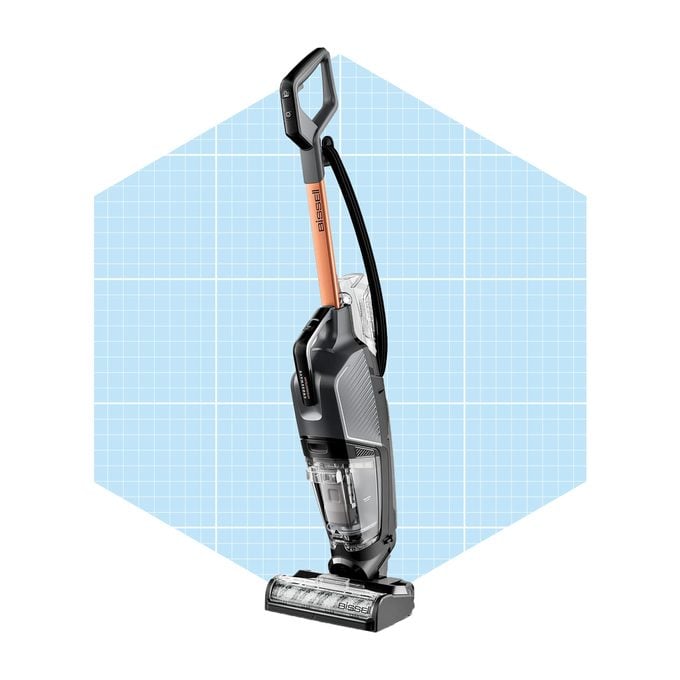
We Tried It

Bissell CrossWave HydroSteam Plus

With this multi-surface wet/dry vac, you can vacuum, wash and steam at the same time.

Bissell CrossWave HydroSteam Plus Features

 Bissell Crosswave Hydrosteam Plus all fittings on floor

The Bissell CrossWave HydroSteam Plus employs Two-Tank Technology that ensures you don’t end up cleaning your floors with dirty water, and has a self-cleaning cycle to run between uses to make sure one mess doesn’t carry over to the next. When used with Bissell’s hard floor sanitize formula in the tank, this machine eliminates 99.9% of bacteria on floors. A special brush roll helps prevent pet hair from getting tangled up in the machine, and light-emitting diode (LED) headlights help you see what parts of the floor still need your attention.

This wet/dry vac comes with two 8-ounce bottles of cleaning solutions (the hard floor sanitize Ffrmula and pet multi-surface formula) so you can put your machine to work right away. It also includes an 8-ounce bottle of Clean Out to use when running the CrossWave’s self-cleaning cycle, and an additional pet multi-surface brush roll and two CrossWave replacement filters.

How We Tested It
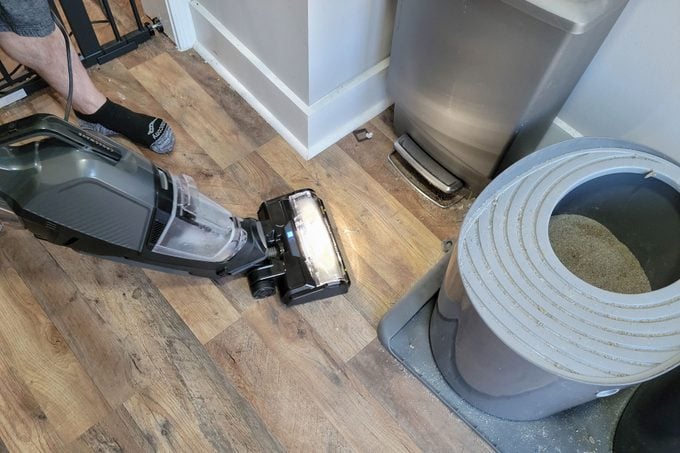
Using vaccum to clean wooden floor

To test the Bissell CrossWave HydrosSeam Plus, I used it in a house that had a variety of surfaces to clean, and a wide variety of pet messes from three dogs and six cats. While it did an outstanding job of cleaning up the accidents of a potty-training puppy, where it really wowed me was how it performed in the areas around cat litter boxes. Many carpet cleaning machines can leave something to be desired in the suction department, but the Bissell CrossWave HydroSteam Plus quickly picks up clay cat litter without leaving a trace behind. If it can make heavy cat litter disappear, you can imagine what it does to daily dirt and debris!

One of my favorite features of this unit is that you can dispense cleaning solution only as needed by using the trigger mechanism on the handle. This allows you to easily suck up messes, like pet urine or kitchen spills, without adding more liquid to the problem, preventing you from spreading it further. Once the liquid is removed, it only takes a few passes with cleaning solution and steam to fully remove any trace of the mess, including odors. This is also beneficial when cleaning up areas around litter boxes, since it won’t saturate any clay particles or dust and end up making a bigger mess.

Another thing I love is the large cleaning tank, which is easy to fill and has excellent visual indicators for adding cleaning solution. And because it only dispenses water and cleaning products as needed, you can steam clean the floors in multiple rooms without needing to continually stop to refill. However, as you move from room to room, you’ll need to find a new place to plug in your machine, as it’s not a cordless model. While this is a small annoyance, it’s ultimately for the best, as the Bissell CrossWave HydroSteam Plus wouldn’t be able to deliver the horsepower needed to clean as well as it does on a cordless battery. That extra horsepower also means this machine is noisier than weaker models on the market, but not overwhelmingly so.

Pros

  • Incredible cleaning power
  • Easy to operate
  • Eliminates messes quickly and thoroughly
  • Works spectacularly on old messes and stubborn stains
  • Lights on the front help ensure you don’t miss a single spot
  • Large cleaning tank with easy-to-read instructions

Cons

  • On the pricey side (but it is a vacuum and steam cleaner in one!)
  • Heavier than other models at 12.5 pounds

FAQ

How long does it take carpet to dry after using the Bissell CrossWave HydroSteam Plus?

The Bissell CrossWave HydroSteam Plus is not meant for cleaning carpets; it’s designed to be used on tile, sealed wood floors, laminate, linoleum, rubber floor mats, pressed wood floors and other flat surfaces, which dry in a matter of minutes (or even seconds!) after cleaning. While it can’t tackle high-pile carpets, it can be used to clean area rugs, runners and low-pile carpets, which will dry quickly in a warm, well-ventilated room.

What Other Reviewers Had to Say

The Bissell CrossWave HydroSteam Plus has earned nearly 500 five-star ratings on Amazon alone. Here’s what real-life users are saying about it:

Verified purchaser, M. Lee, raves, “I’ve tried several products for hardware floors and they’ve all left a residue that seemed to attract even more dirt. This product is amazing! On top of efficiency, vacuum and clean at the same time, it totally conquered a husky pet hair problem with ease. My heavy-duty entryway rugs were cleaned in a few minutesthe dirt and debris this little unit picked up was mind blowing. I am so impressed with this unit. On top of it, when finished cleaning it has a clean-up tray that cleans up the dirty roller for next time. This product is amazing. No more dirty pet hair floors!! Yay!!”

Five-star reviewer, Sam, purchased this product for his “bustling homestead” of dogs, cats, children, chickens, goats and cows. “This all-in-one machine, combining vacuuming, mopping and steam features, has proven to be a monumental time saver, leaving our floors impeccably clean,” he says. “The self-clean mode is particularly impressive, as it effectively prevents animal hair from clogging or tangling around the mop head. In fact, I found this product so effective that I decided to part ways with two other floor-cleaning machines since it excels in performing all their functions.”

“This is by far the best purchase that a dog owner can do,” writes another five-star reviewer, Micaela Seoane. “I’ve been struggling with keeping my floors clean and free of hair of three big-sized dogs for years.” she says. “In 20 minutes, my floors are sparkling and smelling so good. It is extremely easy to use; not heavy at all. I am not a friend of vacuums with a cord, but this one right here [is] worth it. The suction power is great.”

Product Comparison

The Bissell CrossWave HydroSteam Plus is your best option for non-carpeted floors and low-pile rugs. Even though it doesn’t have the word “pet” in its name, it’s still dynamite at cleaning up pet messes! Meanwhile, the Bissell Revolution HydroSteam pet carpet cleaner is specifically designed for carpets, and is able to remove deeply saturated messes and stubborn stains that have penetrated carpet fibers.

Final Verdict

Before and After of floor side by side

The Bissell CrossWave HydroSteam Plus is a miracle when it comes to cleaning up messes. Though it’s not the cheapest wet/dry cleaner on the market, its high horsepower, strong suction and stain-destroying abilities make it well worth the price.

Where to Buy the Bissell CrossWave HydroSteam Plus

We Tried It

Bissell CrossWave HydroSteam Plus

This wet/dry vac tackles everything from pet hair and kitty litter to muddy paw prints and puppy accidents.

The Bissell CrossWave HydroSteam Plus has a suggested retail price of $349.99, and can be purchased directly from the company’s website. You can also buy this mighty machine through retailers like Amazon, Walmart and Target. Please note that the amount of cleaning solution may vary depending on merchant and bundle type selected.


Article source here: We Tested the Bissell CrossWave HydroSteam Plus Vacuum on a Variety of Pet Messes

When Are You Too Old To Move Furniture? Experts Weigh In

While it’s nice to be able to tackle projects around the house yourself, it’s also important to know your limits, especially as you get olde...