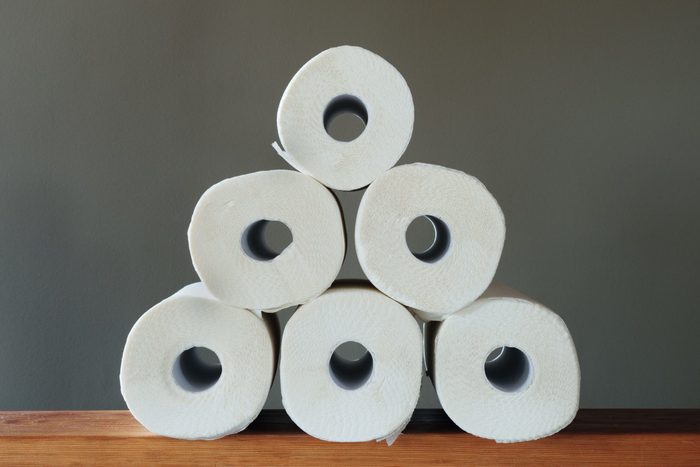
As the saying goes, waste not, want not. That’s certainly true for paper towels, which most people use for every wipe, swipe and spill, as well as some clever household hacks.
They’re a hot commodity these days, so the last thing any of us would want to do is waste them. And yet, if you’ve recently cleaned your mirrors, bathrooms or dusty dressers, you’re guilty of doing just that.
And that’s not the only problem you’ll encounter with these kitchen staples. For starters, paper products aren’t great for the environment, and they’ll also cost you a bundle over time. Plus, this seemingly innocuous choice could be damaging the very items you’re trying to clean!
Here are 15 things you should instead clean with reusable cloths, sponges, brushes or other gadgets. Make these easy swaps and you won’t believe you ever used so many paper towels.
How did we ever live without keyless start cars? From eliminating fumbling with a key ring to all the little-known uses for your car key fob, keyless ignition systems are becoming more and more attractive to consumers. And that’s a good thing, because they’ll soon be universal.
Edmunds.com reports more than half of cars sold in the last year had a keyless ignition system. But as with so many technological advancements comes the inevitable plague … hackers. And that key fob may be their latest target.
When you unlock your car from a distance, the key fob sends an electronic code to your vehicle. According to Jim Milan of Auto Accessories Garage, thieves can actually steal the code as it’s being sent to your car.
“Under normal circumstances, when you are not close to your car, the radial signal the car uses to activate the key is too weak for proper signal communication and the keyless entry feature will not work,” Milan said. “However, when thieves use a special signal amplifier between your car and the key, the car will think the key is next to it and will unlock.”
So how can you protect your key fob from thieves? Store it inside a metal container, says Laura Gonzales of Autonation. The signal from a fob can pass through doors, windows and walls, but metal can stop it. Some suggest storing your fob in the refrigerator or microwave when you get home.
If you feel like you’ll forget your keys in the fridge or — worse — accidentally zap it in the microwave, Mark Cann, founder of Completely Keyless, has a solution. He suggests storing the fob far from where your vehicle is parked so its signals can’t be intercepted. A signal-blocking wallet or pouch would also work.
Portable fire extinguishers successfully put out more than 80 percent of home fires before they get out of hand. But it’s vital to keep the right extinguisher in your home and know how to use it before there’s an emergency.
“There is a saying, ‘An ounce of prevention is worth a pound of cure,’ and I think this holds true for fires,” says Brian O’Connor, technical services engineer with the National Fire Prevention Association.
“Preventing fires from occurring in the first place, through fire safe practices, is of utmost importance. But in the event a fire does occur, fire extinguishers, in the hands of a trained person, can be great for putting out small incipient fires.”
Types of Fire Extinguishers
There are five classes of fire extinguishers. Though they tackle different sources of fire, each operates the same way. The type you need depends on what might catch fire in the room where you keep it, whether it’s the kitchen, workshop or bedroom.
Class A: Fires in ordinary combustibles like wood, paper or cloth.
Class B: Flammable liquids like grease, gasoline, oil and some paints.
Class C: Energized electrical fires caused by tools or plugged-in equipment.
Class D: Flammable metals like magnesium, sodium and lithium.
Class K: Cooking fats and oils in cooking appliances.
Class A, B, and C extinguishers are for homes and businesses. Class D are often found in factories, and Class K in commercial kitchens. That’s according to John Otero, regional director at PuroClean.
Many home extinguishers can be used on different types of fires. They’re labeled for all appropriate classes, like A-B, B-C or A-B-C. For more information, see this blog from the NFPA and this fact sheet.
How To Use a Fire Extinguisher
Only use a fire extinguisher if it’s safe to approach the fire, and keep a safe distance while putting it out. Then remember the acronym PASS:
Pull the pin (or unlock the latch). As you release the locking mechanism, hold the extinguisher with the nozzle pointed away from you.
Aim low. Point the nozzle toward the base of the fire.
Squeeze the lever slowly and evenly.
Sweep the nozzle from side to side until the fire is out.
Stand approximately eight feet from the flames. “If you’re too far away it’s likely the fire won’t be extinguished effectively,” says Thaddeus Harrington, public affairs specialist with the U.S. Consumer Product Safety Commission. “But if you’re too close, the flames could spread even farther, compromising your physical safety too.”
Common Fire Extinguisher Mistakes
Here’s what often goes wrong when people use a home fire extinguisher, according to the experts.
Not reading the instructions: Every extinguisher has steps and precautions on it. Review them from time to time before there’s an emergency. “Reading the instructions in the event of a fire is not the best idea,” says Harrington. “This is because not only will it use up valuable time, allowing the fire to grow, but it may also be difficult to fully comprehend the instructions in a state of panic.”
Standing too close: Remember, the recommended distance is approximately eight feet away.
Where to spray the fire: People often point the nozzle at the top of the blaze and make their way down. Instead, sweep from the bottom up. “This is because the fuel that is feeding the fire will be at its base,” says Harrington.
Forgetting to pull the pin: “In a moment of urgency, failing to remove the safety pin is all too common,” says Harrington. If you don’t pull the pin, the extinguisher won’t work.
Improper extinguisher class: “Some extinguishers expel water, which is great for Class A fires,” says O’Connor. “But if water was used on a Class K cooking oil fire, it would just spread the fire and make things worse.”
Tackling too big of a fire. “Fire extinguishers are not for putting out large fires,” Otero says. “Use them for small fires in confined areas only.”
Other Extinguisher and Fire Safety Tips
Get hands-on training from the local fire departments or fire equipment distributor.
Inspect your fire extinguisher regularly to ensure the pressure gauge is in the operable range and the unit is not damaged or expired.
The true promise of a “smart home” centers around convenience. Smart devices are supposed to make your day-to-day life easier through simple tech solutions.
Unfortunately, today’s smart technology is anything but simple. There are so many smart brands and smart hubs that it seems nearly impossible to make every device in your home communicate and work together.
According to the company that created it, Matter will allow all the smart devices in your home to work together much more smoothly. Matter does not control any of your devices on its own. Instead, it provides pathways for them to communicate with each other regardless of brand.
Theoretically, that means you could control smart devices from Amazon like the Ring Doorbell with devices from competing brands like Google much more seamlessly. Through Matter, smart devices could realize their full potential and create a unified “smart home” experience.
“Taking an open-source SDK [software development kit] approach means everyone that develops a Matter device can use the same code base,” said Tobin Richardson, CEO of the Connectivity Standards Alliance and a member of the Matter Standards Working Group. “That’s an absolutely critical element to ensuring rapid adoption and market success — but we need to get it right.
“The ultimate goal remains to deliver a specification and SDK that delivers on our promise to create a common language for the smart home and improve consumer smart home experiences and spur greater innovation.”
Matter’s emergence could encourage major brands to make their smart devices work together in the early stages of development, creating cross-brand products that can be mixed and matched. Hopefully, 2022 will be the year smart home technology turn less frustrating and clunky and finally lives up to the intelligence its name implies.
If your home is powered all or in part by electricity, you probably view your monthly electric bill with at least a sliver of dread. Depending on where you live, the price for electricity can vary widely.
According to this chart from the U.S. Energy Information Agency (EIA), consumers in New England pay an average of 22 cents per kilowatt-hour of electricity, almost twice as much as those in Kentucky, Mississippi, Alabama and Tennessee. Regional electricity costs depend factors like the type of fuel used, the integrity of the regional power grid, weather conditions and state regulations.
But here’s something else that affects your electric bill — when you use it. In some states and with some power companies, the average amount you pay per kilowatt-hour fluctuates during the day. In what’s known as “time of use” billing, or peak hour/off-peak billing, power companies charge according to demand.
Knowing how electricity peak hours work can save you some money, as well as take some of the strain off your community’s power grid.
What Are Peak Electricity Hours?
These are the times of day when electricity consumption is highest. It varies by season and region.
For residential dwellings, think about the times of day you and your family are most active — watching TV, blow-drying your hair, making coffee, running the dishwasher or tossing in a load of laundry. If everyone else in your community follows the same usage pattern, there’s much higher demand for electricity during those periods. And here’s a new wrinkle affecting peak hours — people charging their electric cars.
The time of year determines peak hours, too. In most parts of the country, when summertime temperatures soar, electricity consumption peaks during the hottest hours of the day as businesses, schools and malls crank the air conditioning.
In contrast, winter months see lower household daytime consumption when homes are more likely to be empty, but peak consumption at night when families return and fire up household appliances.
What Are Time of Use Rates?
Time of use rates (abbreviated as TOU) fluctuate based on peak hours. Power companies charge more for electricity during peak hours and less in off-peak times.
These rates exist for understandable reasons. When there is more pressure on the power grid, it costs more to produce the additional electricity to meet the demand. Higher rates theoretically give consumers incentive to decrease their usage during peak times, lessening pressure on the grid.
Some power companies offer TOU rate plans, guaranteeing a fixed kilowatt-hour rate when you consume electricity during off-peak hours. The difference between peak and off-peak TOU rates varies from company to company, but may be as much as 15 to 20 cents per kilowatt-hour.
What’s the Cheapest Time of Day To Use Electricity?
The formula for finding the cheapest time of day to use electricity is pretty simple — don’t use it when everyone else is!
In practical terms, in most parts of the country, these are considered peak hours:
In summer, typically between noon and 6 p.m. when air conditioners are on full-throttle.
In winter, typically between 6 a.m. and 9 a.m., and again between 5 p.m. and 9 p.m. — before and after work.
Off-peak hours line up like this:
In summer, from about 5 p.m. to 10 p.m., after the hottest part of the day.
In winter, from about 9 a.m. to 5 p.m., when houses are empty and daytime temps are higher
In virtually all seasons and regions, nighttime hours from 9 p.m. or until 5 a.m. are off-peak.
Electricity Money Saving Tips
While it might make financial sense to avoid peak hours, the rhythms of daily life often dictate our electricity use. But there are some ways to take advantage of off-peak rates:
Painting your windows might not be the first project you think of when planning your next home remodel. However, giving your windows a fresh new look doesn’t take much work or cash, and a little goes a long way. Here are five ideas you should consider for painting your home’s windows.
Pick a White That Pops
White paint is timeless. A bright white will pair perfectly with most non-white walls, including grays or a bold color.
One important factor when picking white paint is the sheen. With windows and trim, better to go with a satin or semi-gloss. An expert at your local paint store can help you narrow the choices.
Add a Splash of Color
Bold isn’t for everyone, but for the daring, a vibrant pop of color can add a tremendous focal point to your home. Bright green or orange will make your home stand out. Whether that’s good or bad is up to the beholder.
Make sure whatever window color you choose matches the interior and exterior walls. If you already have a bold wall color, you might want to go with something more neutral for your windows. Or paint the walls a neutral color to better complement your window choice.
Choose Something Moody
Adding color doesn’t have to mean bright or vibrant. A moody color like a dark green is inviting and gives your home a modern, bold look. If you do go this route, consider extending it beyond the windows and painting an entire accent wall that moody color.
Color Match With Your Home’s Décor
If you love that old arm chair, bold colored cabinets or a piece of artwork in your living room, draw that color out and add it to your windows.
The nice thing about this is, you don’t already have to have a bold color in your home. If you purchase the paint color you want for your windows, use extra paint on a dresser, coffee table or something else to tie it back to your windows.
Bring the Outdoors In
Is your home next to the ocean or a lake? Try a nice blue. If you live in the mountains or a heavily wooded area, consider a rich green color. Matching your window paint to the region will remind you every day why you love living there.
Over the eons, wind and water gradually weather rocks, breaking them down into particles that help form soil. That silty sand in your yard might have once been a towering granite cliff. That clay? It could have come from a lava flow of basalt, or limestone that formed under an ancient sea.
Wherever it originated, once it becomes soil, we classify it based on particle size. Sand has the largest particles. Clay has the finest. Silt is somewhere in between. Mix this trio together and voilà! — you have loam, the goddess of garden soils.
What Is Loam Soil?
Loam soil is a balanced mixture of sand, silt and clay, ideal for growing garden plants. Loam’s mineral content, and the way the three sizes of particles work together, combine to make it extremely fertile.
The larger sand grains prevent the soil from compacting, so it drains well and helps oxygen reach plant roots. The extra spaces between the sand attract worms and microorganisms. The silt helps the sand and clay mix together, holds moisture and also makes a good home for microorganisms and decaying organic matter (humus).
The clay also holds water in the soil. Plus, it’s negatively charged, which attracts positively charged nutrients like calcium, iron, potassium, phosphorus and magnesium.
“The ideal soil, called loam, contains all three of these different-sized particles in relatively equal amounts,” says Em Shipman, executive director of KidsGardening.org.
What Are the Benefits of Loam Soil?
Loam soil is considered ideal for garden fruits, vegetables and flowers because it:
Allows water to travel through it slowly enough for the plants to get it, but fast enough to prevent it from getting soggy;
Some gardeners who grow root crops and tubers, or live where there’s a lot of rain, may desire a more sandy soil for ease of harvest and better drainage. Also, some native plants that evolved and adapted to local soil conditions may do fine without loam soil.
When in doubt, apps such as NatureID can help you determine the best soil mixture and nutrients for particular plants.
How Do I Know if I Have Loam Soil?
Besides taking a sample to a lab for a soil test, the easiest way is a squeeze test. Take a handful of moist soil and form it into a ball. If it’s loam, it will compress into a loose ball that crumbles easily.
“If no ball is formed, then the sand content is too high,” says Dr. Tony Provin, soil chemist and professor at Texas A&M University. “If the ball formed could be used by the local youth baseball team, the clay content is likely high.”
How To Create Loam Soil
First, let’s clarify the difference between the soil-science definition and common use of the word loam. In science, loam is soil with a balanced mixture of sand, silt and clay. Commonly it refers to nutrient-rich, crumbly garden soils that contain organic matter.
“Technically speaking, you can’t transform your garden soil into loam by adding sand or clay, because that results in a muddy mess, or worse, almost concrete,” says Shipman.
But you can create more loamy soil in the common sense of the word by adding organic matter. That improves soil structure, or how well the soil particles are held together in clumps by humus, the glue-like substance formed when organic matter decomposes.
“A soil with good structure has lots of these clumps, called aggregates, which loosen heavy clay soil and help sandy soils hold moisture and nutrients,” says Shipman.
Earthworms, microbes and other soil creatures consume and break down this organic matter, transforming it and releasing the nutrients it contains into forms plants can take up. The glue-like humus, which binds soil particles and improves soil structure, forms during decomposition.
Add two or three inches of organic matter. The ideal time is in fall, but you can also do it in early spring.
Work the organic matter into the top six to eight inches of soil with a shovel or rototiller, then wait to plant until spring rolls around. Don’t overdo the rototilling to avoid harming soil life.
If you add fresh (uncomposted) organic material in the spring, wait two to four weeks before planting to let the material start breaking down. Otherwise, microbes can “lock up” some nutrients so plants can’t get at them. However, you can add fully composted material any time and plant seeds or seedlings right away.
Can You Buy Loam Soil?
Yes. “Although quality topsoil is more expensive than cheap fill dirt, it’s worth the investment if you hope to grow a bountiful garden,” says Shipman.
For gardens, Shipman recommends a blend of topsoil and compost. For those who want to get more technical, Provin offers this advice:
“Whenever possible during soil purchasing, look for the abundance of soil peds (natural occurring aggregates), as roots do not grow through individual sand, silt or clay particles, but around these soil aggregates. The lack of aggregates, even in a loam-textured soil, is a root-ability issue.”
How To Maintain Loam Soil
Once you’ve created great loam soil, your garden will be gorgeous for a while. But eventually, nutrients need replenshing.
“Soil improvement is not a one-and-done task,” says Shipman. “Rather, it’s an ongoing process that includes adding organic material to the soil each year.”
Here are some methods to maintain your loam soil:
Organic matter: You can till in organic matter each fall or spring, the same way you first established your loamy soil. You can also add mulch (like leaves) in the fall to protect the soil over winter.
Don’t over-till: Over-tilling the soil will release the stored nitrogen into the atmosphere and wash away nutrients. It also disrupts the habitat created by billions of helpful microorganisms. “More specifically, many gardeners over-till the soil and subsequently destroy native soil aggregation and undo developing aggregation, thus causing root and water problems,” says Provin.
Cover crops:Cover crops planted between growing seasons can protect the soil from erosion by enriching it with nutrients. Alfalfa, buckwheat, barley oats, mustard, parsley, radish, rye, red clover, wheat and winter peas are all good cover crops.
Another trick for healthy soil: Planting native plants.
“The root systems of many native plants are complex and large,” says Mary Phillips, senior director at Garden for Wildlife. “They help sequester carbon and their root channels aid in water run-off and absorption in the soil.”
Provin also recommends that you:
Avoid walking on garden soil, especially when it’s wet. Foot traffic can compact the soil and make it harder for plants to root.
Test the soil annually. Problems can develop from over-fertilization, which introduces too much phosphorus and soluble salts and may skew the soil pH.